Stop abusive traffic before it costs you.
Kernloom acts before your application ever sees the packet - protecting what matters without touching your code.
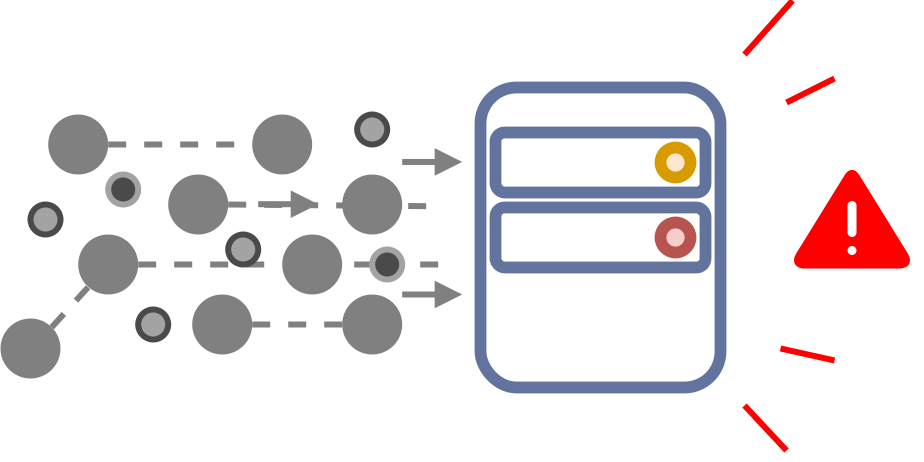
Your stack absorbs traffic it should never see
Without an early filter, every connection reaches your stack — good or bad.
Automated scans. Login pressure. Misconfigured clients. Unexpected internal traffic.
Each event looks small individually. Together, they create load, noise, and downtime risk that is hard to trace until something breaks.
- Web servers and APIs process connection noise instead of real requests
- Login endpoints absorb sustained pressure before any rate limit kicks in
- Downstream systems — WAF, reverse proxy, APIs, and application backends — receive less noise and fewer unnecessary connections

Map what’s normal. Block what isn’t.
Kernloom learns which services talk to which and what that traffic normally looks like. Once you freeze the baseline, any source taking an unrecognised path is blocked immediately.
A compromised service attempting lateral movement. An unexpected peer. A path that has never been seen before. All stopped at the host — without a service mesh, sidecar, or separate control plane.
- Learns normal communication patterns passively — no manual rules required
- Freeze the baseline when you are ready: from that point, unknown paths are blocked
- Full audit trail of every path violation and enforcement action

Observes first. Enforces when you say so.
Kernloom watches incoming traffic and learns what normal looks like for your environment. When something deviates, it responds gradually — first slowing the source, then blocking it if the behaviour continues.
Start in observe mode. Review what it sees. Switch to enforcement only when you are confident.
- Dry-run mode shows every decision before anything is actually enforced
- Automatic baseline learning — thresholds adapt to your real traffic over time
- Self-correcting enforcement: if a source cleans up, the block lifts automatically

Fits your existing stack. Does not replace it.
Kernloom acts earlier in the traffic path than your WAF, proxy, or application. This matters because those systems can themselves become targets.
A WAF under sustained connection pressure still has to process every request. An identity provider receiving login floods still evaluates every attempt. Kernloom reduces that pressure before it arrives.
Your existing tools keep their role. Kernloom reduces what they need to handle.
- Acts before traffic reaches your WAF, reverse proxy, identity provider, or application
- Protects the systems that must stay available: login systems, API gateways, and ZTNA infrastructure
- No changes to existing tool configuration — deploys on the Linux host alongside your current setup
Built for the people who keep the stack running.
Kernloom is designed for the teams responsible for stability, security, and reliability in real production environments.
We need stability under churn — fewer connection spikes, lower CPU pressure, and predictable latency. Without accidentally blocking users behind shared NAT.

Platform Engineering
Ingress & Gateway Owners
We want to start cautiously — see what would be blocked before committing to enforcement — and trust that the system backs off automatically when things normalise.
Security Operations
Blue Team
We measure success by fewer incidents and faster time-to-stability. Anything that keeps the rest of the stack focused on its actual job is a win.
SRE
Reliability & Incident Response
From install to first protection in five minutes.
curl -fsSL https://linkl.it/kernloom | sudo sh
Attach to your interface → observe your traffic → learn your baseline → enforce when ready.
Find out where your stack reacts too late.
Not sure how much exposure your current setup carries?
Answer a few questions about your environment to estimate your exposure level, control gaps, and where Kernloom can reduce risk earlier in the traffic path.